
HVAC Filters vs. Portable Purifiers: A Las Vegas Renter and Owner Guide
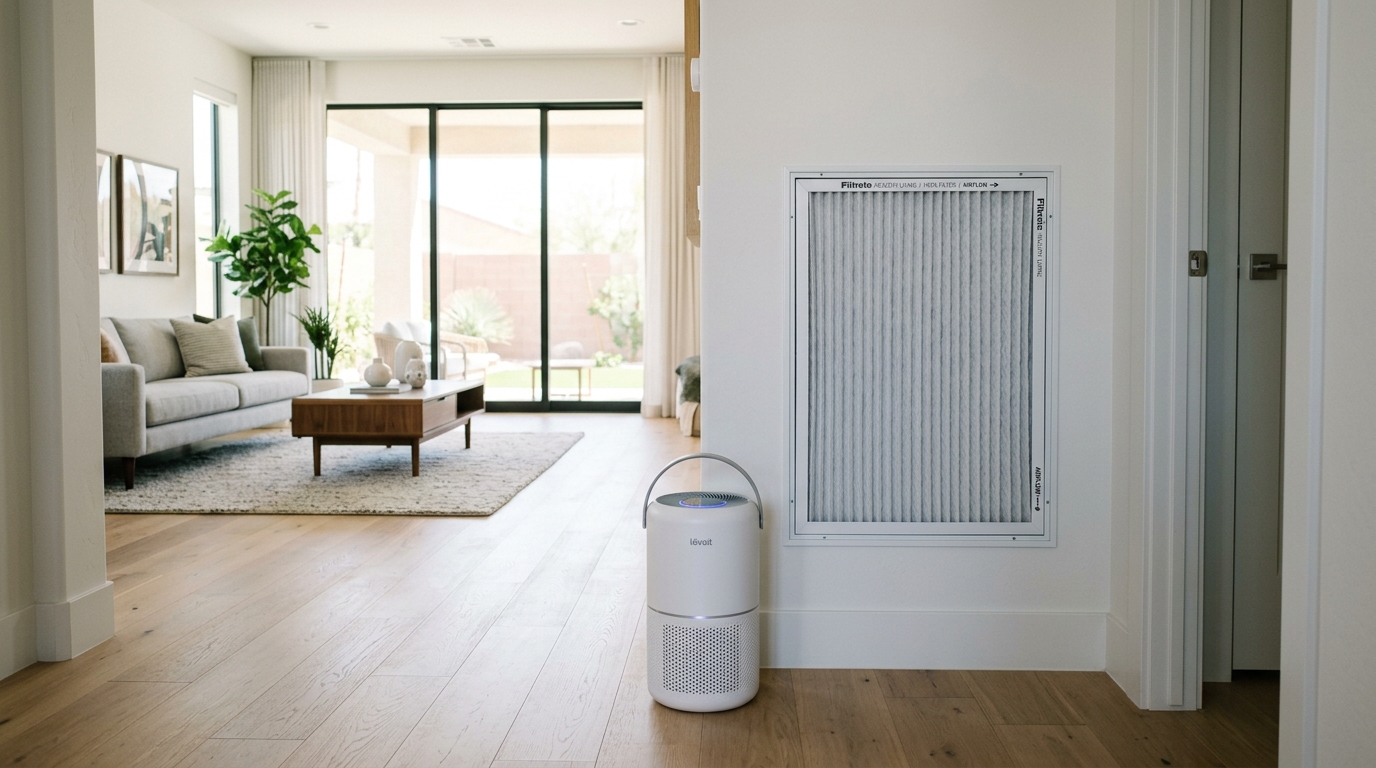
If you live anywhere in the Las Vegas Valley, your air conditioner isn’t an appliance. It’s life support for six months out of the year.
Between desert dust storms, relentless heat cycles, and thin drywall cavities, indoor air quality takes a beating fast. The most common question we get from residents and property owners is simple: Do I buy a thicker furnace filter, or do I buy an air purifier?
Here is the no-BS breakdown based on building physics, field inspections, and equipment survival in the desert.
The 30-Second Rule
- Upgrade your HVAC filter if you control the mechanical closet and the system can handle the airflow—MERV 13 is the gold standard when it fits safely ([2][4]).
- Buy a portable purifier if you’re renting or can’t modify the return cabinet—size it strictly using CADR, not the marketing on the box ([4]).
- Avoid retail gimmicks. Ionizers, ozone gadgets, and plasma glow are marketing hype compared to true mechanical filtration ([4][5]).
Two Different Tools for Two Different Jobs
Don’t treat an HVAC filter and a room air purifier as interchangeable. They perform completely different functions.
| Tool | Primary Purpose | Best Used When... |
|---|---|---|
| HVAC / Furnace Filter | Protects mechanical coils and cleans air circulating through whole-house ductwork | You own the system (or have an accessible return) and duct airflow is balanced |
| Portable Air Purifier | Cleans air inside a single sealed room with a dedicated fan and true HEPA media | You’re renting, bedrooms need immediate help, or wildfire smoke hits the valley |
A thicker furnace filter is not the same thing as a HEPA purifier. True HEPA lives in portables or dedicated mechanical cabinets—not jammed into a skinny 1-inch return slot ([3][4]).
Part 1 — HVAC Filters, in Plain English
What “MERV” Means (Without the Headache)
Filter performance is measured on the MERV scale (Minimum Efficiency Reporting Value) ([2][6]). Higher numbers capture smaller particles (fine silt, dust, and smoke), provided air can still move freely through the system.
Forget memorizing every rating. Here are the only three numbers you need to shop:
- MERV 8: Solid basic pleated filter. Great for dust, lint, and pollen; weaker on the tiniest smoke-sized particles ([2]).
- MERV 11: The step up. Captures finer allergens and dust; useful if MERV 13 is too tight in a 1-inch slot ([2]).
- MERV 13: The high-efficiency upgrade. Captures microscopic particles and smoke—the target most health-oriented guidance points toward when equipment allows it ([2][4]).
Store labels like MPR or FPR? Fine for comparing two filters from the same brand on a retail shelf. For real comparison across equipment, always prefer certified MERV ([2][7]). Also note that UL 900 on packaging certifies flame retardance—not filtration performance.
“But My Tech Said MERV 13 Will Destroy the System”
We hear that all the time. Sometimes it's caution; sometimes it's habit. Here is the honest breakdown:
The Research Side: Studies on residential systems (ASHRAE RP-1299 and research tied to Stephens, Siegel, and Novoselac) found moving to higher-MERV filters usually results in only moderate airflow drop and little net hit to seasonal cooling energy—while fine-particle capture improves dramatically ([8][19]). ASHRAE has consistently pushed back on blanket claims that high MERV automatically wrecks HVAC systems ([2]).
The Street Side: If your return ducts are undersized or the duct system is already gasping, a dense 1-inch MERV 13 filter can tip the unit into weak airflow, coil icing, or high-limit trips ([26]). That isn't you being fancy—that's physics in a restrictive system.
How to handle it correctly:
- Follow any MERV limits established by the equipment manufacturer or your licensed HVAC pro.
- After swapping filters, monitor performance for 48 hours: weak supply register airflow, ice on the refrigerant lines, or short cycling means you need to step down.
- Owners investing in the asset: Installing a 4-inch to 5-inch media cabinet lets you run MERV 13 with far less pressure drop than stuffing a dense 1-inch filter ([18][25]).
- Seal perimeter gaps: Slide the filter in snug. Gaps around cardboard frames allow dirty air to bypass a “MERV 13” completely ([2][4]).
Expectation check: A standard particle filter will not remove paint fumes, bleach smells, or volatile organic compounds (VOCs). That requires dedicated carbon/sorbent beds—not a thin gray “carbon dusting” ([4]).
Part 2 — Portable Purifiers (The Renter’s Strongest Play)
If you can’t enlarge returns, install media cabinets, or argue with a 1990s rental air handler... you’re not stuck. You’re in portable territory ([1][4]).
Size by CADR, Never Box Claims
Ignore marketing claims like "cleans up to 1,000 sq. ft." Look strictly for CADR (Clean Air Delivery Rate)—how rapidly the machine delivers filtered air in standardized tests for smoke, dust, and pollen ([4]).
The EPA Two-Thirds Rule:
Your smoke CADR should equal at least two-thirds of the room’s square footage (assuming standard 8-foot ceilings) ([4]).
- 200 sq. ft. bedroom: Aim for ~130 smoke CADR.
- 300 sq. ft. living area: Aim for ~195 smoke CADR.
- 400 sq. ft. primary suite: Aim for ~260 smoke CADR.
How to Get Real Results in Desert Homes
- Put it where you live: Bedroom first for most people ([4][5]). You spend a third of your life sleeping in that single space.
- Give it clearance: Keep intake and exhaust grilles at least 12 to 18 inches away from walls and heavy drapery.
- Seal the zone: Close bedroom windows while it is running.
- Run it continuously: Running a purifier for 30 minutes a week is expensive décor. Keep it running quietly on low or medium 24/7.
During smoky stretches or high-wind dust storms, a dedicated portable in the bedroom beats wishing the central AC could do magic from a hallway return.
What We Recommend Skipping
Be wary of units that rely on ionization, plasma glow, or “ozone fresh” promises. Stick with straightforward mechanical H13 True HEPA (with activated carbon if you need odor mitigation), and take ozone safety guidance seriously ([4][5]).
Emergency DIY box fans (Corsi-Rosenthal style) can move massive volumes of air during emergencies, provided you use modern motor-fused fans and common sense ([3][5]). For everyday living, a properly sized retail portable purifier is quieter and more energy-efficient.
The Verdict: Filter, Purifier, or Both?
- You own the home / control maintenance: Start with a quality HVAC filter (MERV 13 when the system allows). Add a portable purifier in bedrooms or rooms where you spend extended hours.
- You rent: Never force a dense filter that bows in the frame or whistles—notify management if airflow drops. Buy a portable sized to your bedroom. That’s your highest-ROI move.
- You’re unsure if the system can handle MERV 13: Don't ego-lift the MERV number. Fix duct restriction or stay at MERV 11 and lean on portables ([26]).
How We Maintain Properties at aMaxima Realty
Across our entire managed portfolio in Las Vegas and Henderson, we treat filtration like seatbelts: simple, necessary, and easy to get wrong.
- MERV 13 when the system breathes well: Otherwise, the highest MERV that maintains healthy airflow.
- Renters who cannot alter the handler: Correctly sized portable purifier in the main sleeping area.
- Strict change schedules: 1-inch filters are inspected and replaced on schedule—and sooner following windy desert dust storms.
- Mechanical filtration first: Gimmicky air gadgets last.
Renters
See what’s available and ask about how our rental homes are maintained:
👉 Browse rental listings
Owners
Want HVAC care, filter standards, and property maintenance handled as an engineered system?
👉 Schedule an Owner Consultation · Call (702) 835-9220
Sources & References
- U.S. EPA / NMDOH — Guide to Air Cleaners in the Home
- ASHRAE — Debunking Myths About MERV, Air Filtration
- Clean Air Crew — Agency Consensus on How Air Filters Work
- U.S. Environmental Protection Agency (EPA) — Guide to Air Cleaners in the Home
- American Lung Association — Air Cleaning & Filtration Devices
- Airmid Healthgroup — Understanding MERV, HEPA, and ASHRAE Standards
- Dixon Bros. — MERV vs. MPR vs. FPR: What’s the Difference?
- Stephens et al. — Energy Implications of High-Efficiency Filtration in Residential HVAC
- PubMed / NCBI — Ultrafine Particle Removal and Energy Usage in Residential HVAC
- ASHRAE RP-1299 — The Effects of Filtration on Pressure Drop and Energy Consumption in Residential HVAC Systems
- U.S. Department of Energy (OSTI) — System Effects of High Efficiency Filters in Homes
- Energy Vanguard — Unintended Consequences of High-MERV Filters
This article is for general education in Las Vegas–area homes and rentals. It is not medical or engineering advice. Follow your lease, the equipment manufacturer, and a licensed HVAC technician for system-specific decisions.
About the Author: Raul Esteves Jr
Raul Esteves Jr oversees property operations, maintenance technology, and facility performance at aMaxima Realty and Prop. Mgmt. Grp., LLC. With extensive field experience assessing Las Vegas rental homes and desert building systems, he specializes in practical maintenance standards, indoor air quality, and preventative equipment care.
Need Property Management or Looking to Rent?
From tenant placement to full-cycle property management, aMaxima Realty is here to guide you every step of the way.